Never to Be Brought Back Again
Trump's rhetoric of annihilation as narcissistic abuse & authoritarian performance

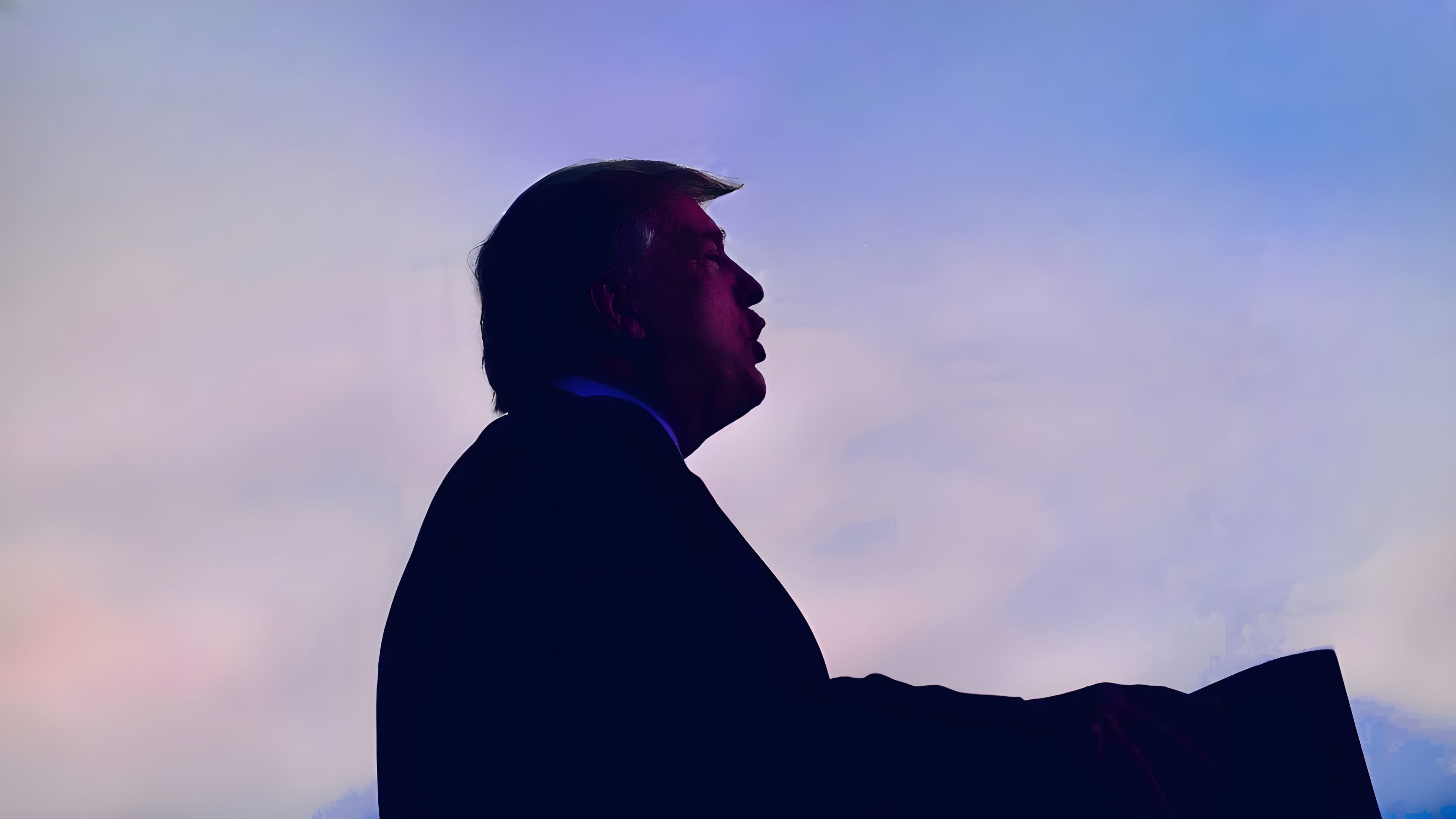
On an April Tuesday, silence settled over the world as the President of the United States wrote via his social media platform that “a whole civilization will die tonight, never to be brought back again.” He added, with the peculiar flourish that has become his signature, “I don’t want that to happen, but it probably will.”
The target was Iran. The ultimatum concerned the Strait of Hormuz. The mechanism specified was the destruction of bridges and power plants; civilian infrastructure, the arteries through which ninety million people sustain their existence.
But the psychological architecture of the threat transcended the immediate geopolitical context. What Americans and the world encountered in that moment was not merely an exercise in diplomatic brinksmanship or even a conventional military ultimatum. It was something much more revealing: the public performance of a narcissistic abuse pattern, now scaled to the dimensions of global power.
Donald Trump’s language of erasure, the promise that something can be made to disappear entirely, “never to be brought back again,” functions simultaneously as political strategy, psychological projection, and authoritarian performance. It is not incidental to his MAGA movement but structural to it.
This rhetoric serves to construct enemies, mobilize grievance, demand absolute loyalty, normalize cruelty, and collapse democratic norms into spectacle. And it does so through mechanisms that would be immediately recognizable to anyone who has survived narcissistic abuse in an interpersonal relationship: idealization followed by devaluation and discard, gaslighting at scale, the projection of one’s own failures and aggression onto the victim, and the demand that the target acknowledge the abuser’s total power over their existence.
To understand this moment—to grasp what it fully means when the leader of a nuclear-armed superpower threatens to erase a civilization as casually as one might cancel a subscription—requires us to move between registers.
We must think politically and psychologically, historically and clinically. We must see Donald Trump’s authoritarian personality not as an abstraction but as a living structure of defenses and demands, and we must recognize how, when given access to the levers of state power, it transforms Trump’s personal pathology into collective catastrophe.
This is an exercise in pattern recognition. And the pattern is clear enough that it demands to be named.
The term “malignant narcissism” entered the clinical lexicon through the work of social psychologist Erich Fromm, who used it to describe a personality structure that merges grandiosity, antisocial behavior, and a sadistic orientation toward others. It is, in Fromm’s formulation, the “quintessence of evil,” not because it represents some supernatural force, but because it describes a human being who has organized their entire psyche around the need to dominate, control, and ultimately destroy anything that refuses to mirror their damaged, distorted, falsely grandiose image of themselves.
Fromm was writing in the shadow of the 20th century’s catastrophes. He had fled Nazi Germany in 1934, and his intellectual project was, in large measure, an attempt to understand how ordinary people could participate in extraordinary evil. His conclusion, developed across works like Escape From Freedom and The Anatomy of Human Destructiveness, was that certain personality structures are particularly drawn to authoritarian movements, and that certain authoritarian leaders exhibit a distinct psychological profile that amplifies and exploits those same tendencies in their followers.
The malignant narcissist, Fromm argued, does not simply want to win. Winning implies a game with rules, an opponent who continues to exist after defeat. The malignant narcissist wants to annihilate: to eliminate the other so completely that no trace remains, no possibility of future challenge, no independent existence that might cast doubt on the narcissist’s grandiose self-conception. This is why the language of erasure is so central to the narcissistic worldview. It is not enough to defeat the enemy; the enemy must be made to have never existed at all.
This clinical insight maps with uncomfortable precision onto the political rhetoric that has become Trump’s signature. Trump’s threat that “a whole civilization will die tonight, never to be brought back again” is not hyperbole deployed for diplomatic leverage. It is the authentic voice of a Narcissistic Personality Disorder psychological orientation that experiences any resistance, any independent existence, as an intolerable narcissistic injury requiring total elimination.
In a typical negotiation between states, an ultimatum specifies demands and consequences. But Trump’s formulation does something else. It positions him, personally, as the arbiter of existence: “I don’t want that to happen, but it probably will.”
The destruction of millions is framed not as a strategic calculation or a tragic necessity but as an extension of his personal will. He alone decides. He alone can grant reprieve. 90 million Iranians are not political actors or even human beings with their own agency; they are extensions of his psychological drama, characters in a narrative whose only author is himself.
This is the logic of narcissistic abuse transposed to geopolitics. In an abusive intimate relationship, the abuser often deploys what psychologists call the “pedestal to pit” dynamic. The target is initially idealized, placed on a pedestal where they exist only to reflect the abuser’s greatness. But when the target asserts independence, when they fail to provide the mirroring the abuser requires, they are devalued, thrown into the pit, rendered worthless and disposable. The threat of annihilation is, for the narcissist, the logical endpoint of this entire process: if you will not exist for me, you will not exist at all.
Trump’s shifting rhetoric about Iran follows this pattern with clinical precision. There were initial reports of “productive conversations.” There was the suggestion that “maybe something revolutionarily wonderful can happen.” And then, when the Iranians demonstrated agency—when they trolled him, when they refused to submit—then came the apocalyptic threat. The language of potential partnership collapsed into the language of extinction.
You were almost my beloved. Now you will be nothing.
Psychoanalyst Otto Kernberg, who has written extensively on malignant narcissism and its expression in leadership, describes how such figures experience the world as divided into two categories: extensions of themselves, which are good and worthy of protection, and independent others, which are threats to be eliminated. The narcissistic leader cannot tolerate the existence of anything outside their control because that outside reminds them of their own limits, their own mortality, their own failure to be the god they imagine themselves to be. Annihilation is not one strategy among others; it is the only response available to a psyche that experiences divergence as attack.
This helps explain what might otherwise seem inexplicable: why the President of the United States would publicly muse about erasing a civilization. The language is not a deviation from the narcissistic pattern. It is the narcissist’s purest expression.
In the aftermath of Trump’s threat, a familiar debate reemerged among commentators and political strategists. Was this genuine danger or mere bluster? Should we take the words literally or dismiss them as performance? The debate itself reveals a fundamental misunderstanding of how authoritarian rhetoric operates, and how narcissistic abuse functions at scale.
The clinical literature on narcissistic abuse describes a phenomenon called intermittent reinforcement. The abuser alternates between kindness and cruelty, between promises and threats, in a pattern designed to destabilize the target’s sense of reality.
One moment you are the most important person in the world; the next you are worthless. One moment there is hope for a beautiful future together; the next you are threatened with total abandonment. The target, desperate to regain the idealized phase of the relationship, becomes hypervigilant, constantly scanning for cues about which version of the abuser will appear next. This hypervigilance is exhausting. It erodes the capacity for independent judgment. It makes the target dependent on the abuser for cues about what is real.
Now scale this dynamic to the level of a nation, or indeed the world. Trump’s public communications follow precisely this pattern of intermittent reinforcement. A threatening post is followed by a seemingly conciliatory one. An apocalyptic ultimatum is softened by the suggestion that something wonderful might still happen. The deadline is set, then extended, then forgotten, then reasserted. The world is kept in a state of anxious uncertainty, never knowing which Trump will appear: the one who speaks of beautiful deals, or the one who speaks of civilizations dying.
This is gaslighting at the largest possible scale. Gaslighting, in its clinical definition, is a form of psychological manipulation that seeks to make the target question their own perception of reality. The term derives from the 1938 play Gas Light, in which a husband manipulates his wife into believing she is going insane by systematically altering elements of her environment and then denying that anything has changed. The goal is not merely to deceive but to destroy the target’s confidence in their own mind.
When a President threatens genocide one day and posts about a “beautiful reset” the next, when he declares that Iranians “are only alive today to negotiate” and simultaneously insists he wants peace, he is not merely being inconsistent. He is engaging in a form of reality distortion that serves a specific psychological and political function.
The inconsistency itself is the point. It destabilizes everyone, allies, adversaries, citizens and journalists, making them dependent on him for the next update, the next clarification, the next tweet that will tell them what to think and feel.
The media ecosystem amplifies this effect. Each outrageous statement generates coverage. Each threat creates a crisis that demands analysis. The attention economy of contemporary media is perfectly calibrated to serve the narcissist’s need for constant mirroring. Trump does not need to govern effectively; he needs only to remain the center of attention. The outrage his threats generate is not a cost of his approach but its fuel.
Political philosopher Jason Stanley, in his essential book How Fascism Works, describes how authoritarian movements deliberately erode the distinction between truth and falsity. The goal is not to replace true statements with false ones but to create a condition in which the very concept of truth becomes meaningless. In such a condition, power becomes the only reality. What the leader says is true because the leader says it, and it will be false tomorrow if the leader says something else. There is no external standard to which the leader can be held accountable because the leader has destroyed the possibility of external standards.
This is why debates about whether to take Trump literally or seriously miss the point. The threat of annihilation is not a statement about the world that can be evaluated as true or false, sincere or performative. It is an act of power whose meaning lies in what it does to those who hear it.
It terrorizes. It destabilizes. It reminds everyone that their existence is contingent on the leader’s whim. It demonstrates, through language alone, that there are no limits.
The language of annihilation has a history. It did not emerge from nowhere in April 2026. It belongs to a tradition of rhetoric that has accompanied some of the darkest chapters of human experience—a tradition that Trump’s words both echo and, in their casual brutality, extend.
The most direct historical parallel is one that Trump almost certainly does not know but that scholars of authoritarian rhetoric recognize immediately. In the second century BC, the Roman senator Cato the Elder developed a practice that would seal his place in the annals of political speech. At the end of every address he delivered to the Senate, regardless of the subject under discussion, Cato would add the same phrase: Carthago delenda est. “Carthage must be destroyed.”
Cato was not making a strategic argument about the Punic Wars. He was engaged in a project of rhetorical annihilation. The repetition of the phrase, its insertion into every debate, its function as the constant base note beneath all other political discourse, served to make the destruction of Carthage seem not like one option among others but like an inevitability, a natural fact, something that simply must happen. By the time Rome actually destroyed Carthage in 146 BC, razing the city, enslaving its population, and according to legend, salting the earth so nothing would grow again—the act felt more like a fulfillment than a decision.
Historian Heather Cox Richardson has written extensively about how authoritarian movements rely on this kind of rhetorical preparation. The language of elimination does not merely precede violence; it enables it. By speaking of enemies as vermin, as cancers, as threats to the body politic that must be excised, the authoritarian leader gradually shifts the boundaries of acceptable action. What was once unthinkable becomes discussable, then plausible, then necessary.
Trump’s language about enemies—whether they are political opponents, immigrants, or foreign nations—consistently draws on this vocabulary of dehumanization. The “enemy within.” “Vermin.” “Crazy bastards” who must be dealt with. This is not colorful language or mere insults. It is the rhetorical groundwork for violence.
As philosopher Kate Manne has argued, dehumanization is not primarily a cognitive error (a failure to recognize the humanity of others), but a practical orientation. It is a way of relating to others that licenses treatment that would otherwise be prohibited.
Legal scholar Philippe Sands, in his haunting book East West Street, traces how the concept of genocide emerged from the work of two Jewish lawyers, Raphael Lemkin and Hersch Lauterpacht, who survived the Holocaust and dedicated their lives to creating legal frameworks that would prevent its recurrence. Lemkin coined the term “genocide” to describe not only the act of killing but the attempt to destroy a group as a whole—to eliminate not just individual members but the collective existence of a people, their culture, their memory, their future.
Crucially, Lemkin understood that genocide begins in language. The physical destruction of a group is preceded by its symbolic destruction: the erasure of its name, its history, its right to exist.
Trump’s threat to ensure that “a whole civilization will die tonight, never to be brought back again” is, in this sense, an act of symbolic genocide even if no bombs ever fall. It declares that the continued existence of Iran is not a fact of geography and history but a privilege that can be revoked at will. It erases the independent reality of 90 million people and replaces it with a condition of contingent existence: you are only alive because I allow it.
Former State Department legal advisors and international law experts have noted that this language meets the threshold for a threat of genocide under international law. The Geneva Convention prohibits “acts or threats of violence whose primary purpose is to terrorize a civilian population.”
The specific promise that something will be “never to be brought back again” is not ambiguous. It describes annihilation, not defeat. It describes the end of a people, not the end of a regime.
Cato’s repetition of Carthago delenda est was not, in its own time, universally understood as a call to genocide. It was seen as strong rhetoric, as patriotic fervor, as the colorful speech of a passionate senator. Only in retrospect, after Carthage was actually destroyed, did the connection between the words and the act become undeniable.
We are living in the before of a similar pattern. The words are being spoken. The rhetorical groundwork is being laid. What comes next depends on whether we recognize the pattern while there is still time to interrupt it.
Political theorist Theodor Adorno, writing in the aftermath of the Holocaust, sought to understand what made certain individuals susceptible to fascist appeals. His research, conducted with colleagues at the University of California, Berkeley, produced the concept of the “authoritarian personality”: a cluster of traits including submission to authority, aggression toward outgroups, rigid conventionalism, and a tendency toward conspiratorial thinking. Adorno understood that authoritarianism was not simply a political ideology but a psychological structure, a way of organizing the self in relation to power.
Psychologist Bob Altemeyer later refined this work with his concept of “Right Wing Authoritarianism,” identifying three core components: authoritarian submission (the tendency to defer to established authorities), authoritarian aggression (the tendency to attack those identified as enemies by those authorities), and conventionalism (the adherence to traditional norms).
Altemeyer’s research demonstrated that individuals high in these traits are not merely conservative in the conventional sense; they are oriented toward a particular kind of relationship with power, one in which their own identity is subsumed into a larger collective defined by its opposition to designated enemies.
What Adorno and Altemeyer understood, and what contemporary psychology has confirmed, is that authoritarianism is fundamentally relational. It is about the bond between leader and follower, the shared investment in a mythologized past and a purified future, the collective hatred of those who are seen as threats to that vision.
The authoritarian leader does not merely articulate policies that appeal to followers; he offers a form of psychological compensation. Submission to the leader promises relief from the burdens of individual autonomy. Hatred of the enemy promises a sense of power and purpose. The fusion of self and movement promises an escape from the anxieties of modern existence.
Fromm called this “the escape from freedom”—the flight from the difficult work of self-determination into the comforting embrace of authoritarian certainty. In a world of complexity and ambiguity, the authoritarian leader offers clarity: we are good, they are evil, follow me and you will be safe. The cost of this clarity is the surrender of critical thinking, moral autonomy, and ultimately the capacity to recognize the humanity of those designated as enemies.
Trump’s relationship with his followers exemplifies this dynamic. His base does not merely support his policies; they are invested in his person. Insults directed at him are experienced as insults to themselves. Threats to his power are experienced as existential dangers. This is not normal political affiliation. It is a form of identification that mirrors the dynamics of a narcissistic family system, in which the patriarch’s emotional needs structure the entire relational field.
In such systems, the leader’s enemies become everyone’s enemies. The leader’s grievances become shared grievances. The leader’s demand for loyalty becomes a test of membership in the community. Those who dissent are not merely disagreeing; they are betraying the family, aligning themselves with the enemy, choosing annihilation over belonging.
This is why Trump’s rhetoric of annihilation is not a liability with his base but a feature. The threat to destroy a civilization demonstrates the leader’s power. It shows that he is willing to do what others will not. It confirms that enemies who have been designated as threats will be dealt with decisively. The cruelty is not a bug; it is the point.
Journalist Adam Serwer captured this dynamic in his essential essay The Cruelty Is the Point. Writing about Trump’s immigration policies and the visible pleasure his supporters took in the suffering of migrants, Serwer argued that cruelty functions as a form of social bonding. The shared willingness to inflict pain on designated enemies creates solidarity among the in-group. It proves that you are truly one of us, that you have overcome the weak scruples that prevent others from doing what must be done.
This insight applies with equal force to Trump’s international rhetoric. The threat to annihilate Iran is not merely a message to Iran. It is a message to his supporters: I am strong enough to erase a civilization. I am not constrained by the norms that limit lesser leaders. My power is absolute, and by extension, your identification with me gives you a share in that power. You too can stand above the timid masses who worry about consequences and proportionality. You too can experience the thrill of total dominance.
Psychoanalyst Heinz Kohut, whose work on narcissism transformed clinical understanding of the condition, described how narcissistic leaders serve a “self object” function for their followers. The leader becomes an extension of the follower’s own fragile self esteem, a figure whose grandiosity compensates for the follower’s sense of inadequacy. The follower does not merely admire the leader; the follower experiences the leader’s triumphs as their own. When the leader threatens to annihilate an enemy, the follower feels powerful, enlarged, liberated from the constraints of ordinary life.
This is the psychological engine of authoritarian mobilization. It is not rational. It cannot be countered with facts or reasoned arguments. It operates at the level of affect and identity, offering emotional rewards that are more compelling than any policy outcome. Understanding this is essential for anyone who hopes to counter authoritarian movements. You cannot argue someone out of a psychological need. You can only offer an alternative source of meaning, identity, and belonging.
Heather Cox Richardson, an American historian and author whose nightly letters have become essential reading for those trying to understand these troubled times during the decline of American democracy, has developed a framework that illuminates the deeper structure of Trump’s appeal.
She argues that authoritarian movements invariably rely on a mythologized past, a golden age that has been lost and must be restored. This past never actually existed in the form its proponents imagine, but its power lies precisely in its unreality. Because it is a fantasy, it can contain whatever its adherents need it to contain. It can be perfectly pure, perfectly ordered, perfectly homogeneous.
The slogan “Make America Great Again” is the most visible expression of this dynamic, but the pattern extends far deeper. The restoration narrative provides an explanation for present suffering and a promise of future redemption. We were once great. We have been betrayed, weakened, polluted by outside forces. If we eliminate those forces and return to the pure past, we will be great again.
This narrative has a particular resonance for populations experiencing status anxiety, or the fear of losing one’s place in a social hierarchy. Sociologist Arlie Russell Hochschild, in her study of Tea Party supporters in Louisiana, described this as the “deep story” that structures Conservative grievance. It is a story about waiting in line for the American dream, playing by the rules, and watching as others—racial minorities, immigrants, the undeserving—cut in line ahead of you. The government, in this story, is not a neutral arbiter but an active agent of this injustice, helping the line-cutters at the expense of those who have waited patiently.
Trump’s genius was to recognize that this deep story could be mobilized politically. His rhetoric of annihilation is directed at the perceived line-cutters—the immigrants, the foreign competitors, the internal enemies who have supposedly stolen what rightfully belongs to his supporters.
When Trump threatens to wipe out a civilization, he is not speaking to Iran. He is speaking to the millions of Americans who feel that their rightful place in the world has been taken from them, who experience the complexity of globalized modernity as a personal insult, who long for a world in which American power was unchallenged and their own status was secure.
Heather Cox Richardson emphasizes that this longing for a mythologized past is not incidental to authoritarianism but central to it. The promise of restoration justifies the destruction of present institutions. The Constitution, with its checks and balances, is portrayed as an obstacle to the restoration of true American greatness. The media, with its insistence on factual accuracy, is portrayed as an enemy of the people. The democratic process itself, with its messiness and compromise, is portrayed as a corruption of the pure will that the leader alone can channel.
So in a very real sense, Trump’s threat to annihilate an entire civilization is not a departure from his domestic agenda, but its international expression. The same logic that justifies purging the “enemy within” justifies erasing the enemy abroad. Both are obstacles to the restoration of the mythologized past. Both must be eliminated so that the golden age can finally arrive.
The tragedy, of course, is that the golden age never arrives. It cannot arrive because it never existed. The promise of restoration is a perpetual motion machine of grievance. The enemies are never fully eliminated. There is always another line-cutter, another threat, another betrayal. The leader must constantly identify new targets because the psychological economy of authoritarianism requires an endless supply of enemies. Annihilation is not a means to an end. It is the end itself.
In the days following Trump’s threat, a revealing pattern emerged in the behavior of those closest to him. Defense Secretary Pete Hegseth offered prayers for “overwhelming violence.” Advisors surrounded the President with what one aide described as a “human printer”—a constant stream of worshipful information designed to protect his fragile ego from any contact with reality. The machinery of the administration adjusted itself to accommodate and amplify the President’s apocalyptic rhetoric rather than contain it.
This is the role of what therapists who work with survivors of narcissistic abuse call the “flying monkeys” (a term borrowed from The Wizard of Oz) to describe the enablers who do the narcissist’s bidding. In an abusive family system, these are the relatives who pressure the victim to reconcile, who explain away the abuser’s behavior, who insist that the victim is overreacting or misremembering. Their function is to maintain the closed system of the abuser’s reality, to ensure that no external perspective can penetrate and challenge the narcissist’s grandiosity.
In the political realm, the flying monkeys take the form of advisors, media figures, and political allies who translate the leader’s pathology into policy. They do not merely obey, they elaborate. They take the raw material of the leader’s rage and grandiosity and transform it into legal justifications, strategic rationales, and theological affirmations.
The Crusader imagery—Deus Vult, “God wills it”—that has appeared in the discourse surrounding Trump’s foreign policy is not incidental. It sanctifies his narcissistic demands, transforming a personal need for dominance into some kind of holy mission.
Journalist Ezra Klein has written extensively about how political institutions are shaped by the personalities of those who inhabit them. Institutions, he argues, are not neutral containers. They are patterns of behavior that can be strengthened or degraded by the people who operate within them. When a person with a malignant narcissistic personality structure occupies the Presidency, the institution itself begins to take on the characteristics of that personality. Norms that once constrained behavior are eroded. Advisors who once provided reality checks are replaced by those who provide only validation. The entire apparatus of government is reorganized around the emotional needs of a single individual.
This is what we witnessed in the days after the annihilation threat. There was no cabinet meeting where sober officials discussed the strategic implications. There was no congressional consultation. There was no apparent recognition that threatening genocide might have consequences for American interests, American alliances, or American values. There was only the endless amplification of the leader’s words, the scrambling to make sense of the senseless, the collective performance of loyalty that is the only currency that matters in an authoritarian court.
NYU professor, historian and political scientist Ruth Ben-Ghiat, who has spent her career studying authoritarian leaders, describes this as the “cult of the leader.” In authoritarian systems, she explains, loyalty to the person of the leader supersedes loyalty to institutions, laws, or the nation itself. The leader is the state, and service to the leader is service to the nation.
This conflation of person and office is precisely what the American Constitutional system was designed to prevent. The President was to be a temporary occupant of a permanent office, constrained by laws and accountable to the people. But when the cult of the leader takes hold, those constraints dissolve. The leader becomes the law. The leader’s whims become policy. The leader’s psychological needs become national priorities.
Writer Masha Gessen, reflecting on their experience covering Vladimir Putin’s Russia, has described how authoritarian systems generate a particular kind of cognitive dissonance in those who live under them. The gap between official reality and observable reality becomes so vast that people stop trying to reconcile them. They simply accept that there are two realities: the one the leader proclaims and the one they experience. Navigating between them becomes a survival skill. But over time, the capacity to distinguish between the two erodes. The leader’s reality becomes, for all practical purposes, the only reality that matters.
This is the condition toward which the United States has been drifting. A President threatens to annihilate a civilization. His supporters celebrate his strength. His advisors amplify his message. The media covers the spectacle. And the rest of us are left to navigate between what we know to be true—that threatening genocide is both morally abhorrent and strategically insane—and what the system demands we accept as normal political discourse.
On the night following Trump’s threat, Bruce Springsteen took the stage in Los Angeles. The E Street Band was beginning its Land of Hope and Dreams tour, and Springsteen, who has spent five decades chronicling the promises and betrayals of American life, offered what he called “a prayer for our men and women in service overseas” before moving to something else: an invocation of what America has meant and what it might still mean.
“The America I love,” Springsteen said, “the America that I’ve written about for fifty years, that has been a beacon of hope and liberty around the world, is currently in the hands of a corrupt, incompetent, racist, reckless, and treasonous administration.” He called on the audience to choose “hope over fear, democracy over authoritarianism, the rule of law over lawlessness, ethics over unrivaled corruption, resistance over complacency, truth over lies, unity over division, and peace over war.”
The moment was striking not only for its content but for its form. Here was an artist with a guitar, not a podium, saying what needed to be said. No handlers, no focus-grouped talking points, no careful calibration. Just a musician on a stage in Los Angeles telling the truth as he saw it: that something has gone terribly wrong, and that pretending otherwise is no longer an option.
This is what artists do when the ground starts to shift beneath them. They bear witness. They look at the official story and say, out loud, that it’s a lie. They remind us that the way things are is not the way things have to be. Springsteen wasn’t offering a policy agenda or a 5 point plan. He was doing something simpler and maybe more important: refusing to accept that this—the threats, the cruelty, the slow unraveling of everything decent we once knew about America—is just how it is now.
Throughout history, in every country that has slid toward authoritarianism, you find this same figure. The singer, the painter, the poet, the playwright who stands up in the middle of the nightmare and says, “I see what’s happening, and I’m not going to pretend I don’t.”
They don’t always change the outcome. But they do something essential: they let the rest of us know we’re not crazy. That the reality we perceive is real. That another world, a better one, remains possible, even when it feels impossibly far away.
But the deeper significance of Springsteen’s statement lies in what it reveals about the nature of resistance to narcissistic abuse at scale. In an interpersonal context, survivors of narcissistic abuse often describe the moment of awakening: the realization that the problem is not their own inadequacy but their abuser’s pathology. This realization is liberating, but also terrifying. It means accepting that the relationship cannot be repaired, that the golden age will never arrive, that the only path forward is to leave.
Nations cannot leave their leaders in the same way individuals can leave abusive partners. There is no moving out, no going no contact, no starting over somewhere else. The abusive leader controls the apparatus of the state. The relationship must be transformed from within, through the slow, difficult work of political organizing, institutional defense, and cultural resistance.
American feminist, writer and activist Rebecca Solnit, in her work on hope and crisis, has argued that the most important act in dark times is to refuse the narrative of inevitability. Authoritarian leaders rely on the perception that their victory is assured, that resistance is futile, that the only rational response is submission. Every act of refusal, every protest, every piece of critical journalism, every assertion of independent reality, undermines this perception. It creates space for alternatives. It reminds people that the current arrangement is not permanent, not natural, and not the only possible world.
This is why naming things matters. Calling Trump’s rhetoric what it is, a manifestation of malignant narcissism, a threat of genocide, an act of authoritarian performance, is not merely an exercise in labeling. It is a form of resistance. It refuses to accept the terms the abuser offers. It insists on a reality outside the abuser’s control. It testifies that the annihilation of a civilization would be a crime, not a reset, not a deal, not a demonstration of strength.
Historian Timothy Snyder, whose work on the Holocaust and Eastern European authoritarianism has made him one of the most incisive pundits and scholars of our moment, argues that the most important lesson of the 20th Century is that institutions do not defend themselves. They are defended by people who recognize what is at stake and act accordingly.
The Weimar Republic did not fall because it was doomed by history. It fell because too many Germans who could have defended it chose not to, either out of complacency, fear, or secret sympathy with its enemies.
Snyder’s warning applies with uncomfortable force to today’s United States. The threat to annihilate a civilization was met not with universal condemnation but with the familiar cycle of outrage and normalization.
Some condemned Trump’s threat. Some explained it away. Many simply turned their attention to the next spectacle. The machinery of democratic accountability— Congressional investigations, independent journalism, civic mobilization—groaned but didn’t really engage.
This is the dynamic that must be broken if the pattern is to be interrupted. The rhetoric of annihilation must be met with accountability. The performance of state cruelty must be met with organized labor strikes and solidarity. The demand for loyalty to one Fearless Leader must be met with our demand for loyalty to American democratic principles. None of this is guaranteed to succeed. But all of it is necessary.
What does it mean to recognize the pattern we are living through? What becomes possible when we see Trump’s rhetoric of annihilation not as a series of isolated outbursts but as a coherent psychological and political strategy?
First, recognition allows us to stop being surprised. The narcissistic abuser’s behavior follows predictable scripts. The idealization gives way to devaluation. The promises of a beautiful future alternate with threats of total destruction. The demand for absolute loyalty is enforced through public humiliation of dissenters. None of this is new, and none of it is particular to Trump. It is the anatomy of a personality disorder that has existed as long as human beings. Recognizing the pattern means we can anticipate what comes next and prepare accordingly.
Second, recognition clarifies what is at stake. This is not normal politics. The threat to annihilate a civilization is not a negotiating tactic. It is the authentic voice of a psychological orientation that cannot tolerate the existence of anything outside its control. When such a voice speaks from the Oval Office, the danger is not merely to American interests or international stability. It is to our fundamental principles that human beings have a right to exist, that civilizations cannot be erased at the whim of a single madman.
Third, recognition points toward the work that must be done. The problem is not simply one man but the system of enablement that surrounds him. The flying monkeys who translate his pathology into policy. The media ecosystem that amplifies his spectacles. The followers who get off on his cruelty. Dismantling this system requires more than defeating Trump at the ballot box, though that is essential. It requires rebuilding the institutions and norms that made his rise possible. It requires addressing the status anxiety and existential dread that make authoritarian appeals attractive. It requires offering an alternative vision of American identity that does not depend on the mythologized past or the designated enemy.
Writer Ta-Nehisi Coates has argued that the central drama of American history is the struggle between those who believe in the country’s founding ideals and those who believe in upholding the racial and economic hierarchy those ideals were designed to obscure. Trump’s rhetoric of annihilation is the latest expression of the latter—the tradition that sees a select group of people as fully human and others as disposable objects to be eliminated. Resistance to Trump is the latest expression of the tradition that insists, against all evidence, that the promise of liberty and justice for all might yet be realized.
The arc of history does not bend inevitably toward justice. It bends toward whatever human beings make it bend toward, through both their actions and their failures to act.
This is how catastrophes begin, not with a bang but with a threat that is met with a collective shrug, a line that is crossed so gradually that no one can say exactly when the crossing happened.
And yet, here were millions of people worldwide who heard Trump’s threat and felt, viscerally in their bodies, the human recognition: this is wrong. This cannot stand.
Philosopher Theodor Adorno, who understood better than most how civilization could collapse into barbarism, also understood that the capacity to recognize wrongness is the seed from which resistance grows. He wrote, in the shadow of Auschwitz, that the only valid response to the catastrophe was to ensure that nothing like it could ever happen again.
This required not optimism but clarity: the clear-eyed recognition of what human beings are capable of doing to one another, and the equally clear-eyed commitment to building a world in which such things become impossible.