A Bridge Remembers
An open letter to the six justices who formed the majority in Louisiana v. Callais

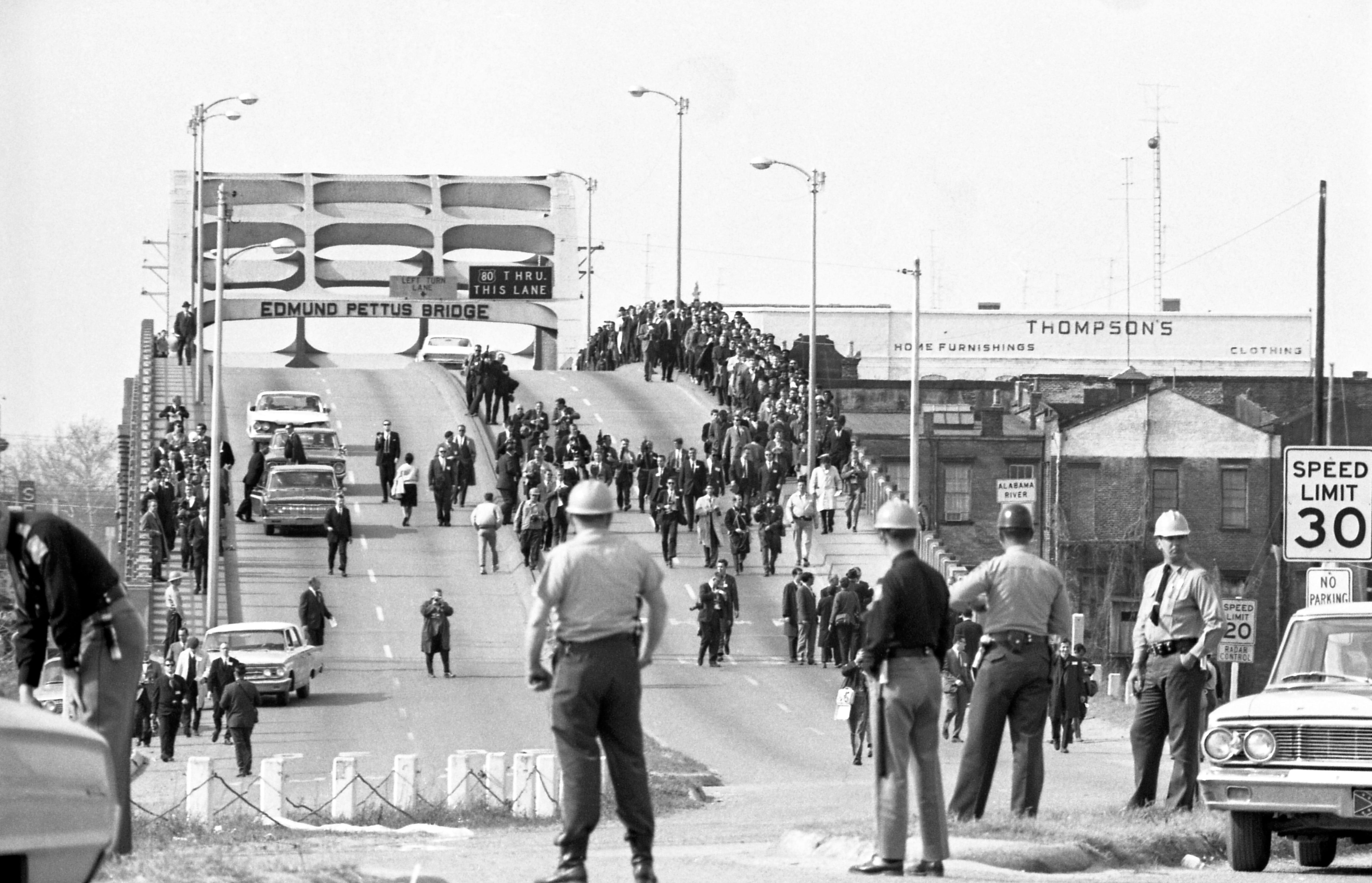
There is a photograph I cannot stop returning to. March 7, 1965. John Lewis and Hosea Williams stand at the crest of the Edmund Pettus Bridge in Selma, Alabama, six hundred people behind them.
They are dressed for church. They are carrying nothing. They are walking toward Montgomery because a state trooper had shot Jimmie Lee Jackson in the stomach for the crime of trying to protect his mother during a voting rights march. Jackson was 26 years old. He was an army veteran. He died eight days after he was shot, on February 26th, and his death became a clarion call.
Everyone knows what happened next. Sheriff Jim Clark and his deputies and the Alabama state troopers met those 600 people at the foot of the bridge with clubs, bullwhips, tear gas, horses, and cattle prods.
John Lewis’s skull was fractured. Amelia Boynton Robinson was beaten unconscious and left in the road. Seventeen people were hospitalized. That night, ABC interrupted its broadcast of Judgment at Nuremberg to air the footage. Americans watching a film about the crimes of fascism looked up to find their country’s deputies on horseback, doing what enforcers of this country’s systems do to black bodies that insist on belonging.
Eight days later, Lyndon Johnson stood before a joint session of Congress and spoke the words of the movement itself into existence: We shall overcome.
The Voting Rights Act was signed into law on August 6th, 1965. Less than five months after the Edmund Pettus Bridge.
I am revisiting this history carefully. Not because you don’t know it, I know you do, but because I want you to hold it in your minds while I remind you what you have done.
This week, you struck down Louisiana’s map creating a second majority-black congressional district. You ruled that compliance with the Voting Rights Act cannot, on these facts, justify a race-conscious remedy.
You concluded, with the full authority of the Supreme Court of the United States, that the fix for racial discrimination in voting is itself the problem. The remedy, in your telling, is the crime.
And you did it using the Fourteenth Amendment. Hold that for a moment.
The Fourteenth Amendment was ratified in 1868, drafted in the blood and ash of a Civil War that cost hundreds of thousands of lives, to guarantee equal citizenship to the people this country had held in bondage for two and a half centuries. The Fifteenth Amendment followed two years later, promising that the right to vote could not be denied on account of race. Both amendments granted Congress explicit authority to enforce those guarantees. And for a brief, extraordinary window, they did.
Then came 1877, the deal that ended Reconstruction, the Federal withdrawal, and what followed: nine decades of terror and disenfranchisement, of poll taxes and literacy tests, of fraud and intimidation and murder visited on anyone who attempted to make those amendments mean what they said.
The Voting Rights Act of 1965 was the long-deferred completion of a sentence that the Fourteenth and Fifteenth Amendments had first begun. Section 2, the provision at the center of your ruling, is the mechanism by which voters have been able to challenge district maps drawn not with locked courthouse doors but with careful lines—lines calibrated, in a shameful tradition as old as this country itself, to make some people’s votes matter less than others.
Now, I want to talk about what that law cost. Not in the abstract. Specifically.
It cost Jimmie Lee Jackson his life. He wanted to vote, and was killed for that wish.
It cost James Reeb, a Unitarian minister from Boston who answered the call to Selma and was beaten to death by white men on a sidewalk four days after Bloody Sunday.
It cost Viola Liuzzo, a mother of five from Detroit who drove marchers home through the dark Alabama night and was shot dead by Klansmen for the transgression of being a white woman in a car with black men.
It cost John Lewis’s skull, and Amelia Boynton Robinson’s body left in the road, and the names of people who prayed and marched and bled at the edge of a bridge for a right this country had promised them a century before, and still refused to honor.
Fannie Lou Hamer, testifying before the Credentials Committee at the 1964 Democratic National Convention, described what it cost in Mississippi just to try: the eviction from the plantation where she’d worked as a sharecropper for eighteen years, the beating in a Winona jail cell, the shotgun blasts fired into the homes of people who dared register to vote.
Is this America, she asked, the land of the free and the home of the brave? It was a genuine question. She was not being rhetorical. She genuinely needed to know.
That question purchased the Voting Rights Act, too. Paid for in the currency of lives interrupted, dignity stripped, futures foreclosed.
And now, knowing what it cost, you have taken the Fourteenth Amendment, the one written to protect those people’s descendants, and frankly, all of us from exactly this kind of subordination, and you have wielded it to declare that giving their communities actual political power constitutes an impermissible act of racial sorting.
There is a word for that. The word is betrayal. Not just of legal theory and precedent, which you have willfully overlooked and ignored. Not even a betrayal of your own credibility in legislating from the bench, although there is also that. Of actual human beings. Of the human beings who paid a tremendous price, who went to hell and back, for the specific law you have just gutted.
You have dressed this betrayal in the language of colorblindness, as though invoking the idea of not seeing race is the same thing as having racial equality. As though the conjuring trick of neutrality changes anything about who benefits from the map as drawn and who loses.
James Baldwin understood this move. He spent a career naming it: Not everything that is faced can be changed, he wrote, but nothing can be changed until it is faced. Colorblindness is the refusal to face the deeply embedded racial injustices of this country. It does not produce justice; it insulates injustice from legal remedy while insisting, with great rhetorical confidence, that it cannot see a thing.
You call it originalism. You call it fidelity to the text. But the text of the Fourteenth Amendment was written by men who had just watched this country tear itself apart over slavery and who understood that black Americans would need its protection from exactly the kind of sophisticated disenfranchisement that does not require a locked door, only a carefully drawn line.
You’ve taken their words and built from them a fortress against the very people those words were written to defend. I don’t know what to call that but a perversion of the original intent so thorough, it deserves its own brand of conniving trickery.
I am not writing this because I think it will change anything. The law, for now, is what you say it is.
I am writing because John Lewis spent sixty years telling us that democracy is not a destination, it is a march. That the arc of justice is long, and we are the ones who bend it. That you do not leave a bridge just because someone is standing at the other end with a club.
Do not get lost in a sea of despair, he wrote, in one of his last public letters, addressed to a country he had spent his life trying to save. Be hopeful, be optimistic. Our struggle is not the struggle of a day, a week, a month, or a year, it is the struggle of a lifetime.
He wrote that in the summer of 2020, while he was dying.
I am writing all this because some things deserve to be spoken aloud, directly, to the people responsible for them. Not to a general audience. Not for the comfort of those who already agree. To you. The six of you, specifically, who wrapped the stripping of voting power in the vocabulary of the very amendment that was supposed to ensure that stripping could never happen again.
Amos didn’t address the injustices of his day in abstract terms. He named the people benefiting from it. He told them precisely what they were doing, and what it would cost. I am not him. But I understand the tradition.
Do you understand what was sacrificed for what you’ve now destroyed?
Jimmie Lee Jackson wanted to vote. He was shot for it. Viola Liuzzo drove marchers home in the dark and never saw home again. James Reeb answered a call to stand with his neighbors and was beaten to death on a Selma sidewalk.
They gave their lives for something you have now handed back, wrapped in the elegant rationalism of Constitutional law, using the very language of protection to accomplish the age-old work of exclusion.
History will have its say about what this moment means. Scholars will write about it. Advocates will cite it. Future justices will argue over it.
But so will that bridge. So will the blood on the pavement.
So will Jimmie Lee Jackson, and Viola Liuzzo, and James Reeb, and Fannie Lou Hamer, and every name carved into the long American ledger of people who were told to wait, then beaten for praying, then buried for believing the Constitution meant what it said.
You will wear this day as a cloak of shame for the rest of your lives. And long after you are gone, that bridge will still be standing, and it will still remember everything.
Daniel Lawson is a writer, creator and advocate based in New York, where he covers politics, culture, current events and the ongoing struggle to make the promises of this country live up to what we say they do.
If this piece resonated with you, share it with someone who needs it. And if you believe this kind of writing matters, consider becoming a paid subscriber. It's how this work stays independent, and how I keep showing up.